

 Image 1 of 1
Prepare your business to recover from technology failures, cyberattacks, data loss, system outages, and other disruptive events with a comprehensive disaster recovery framework.
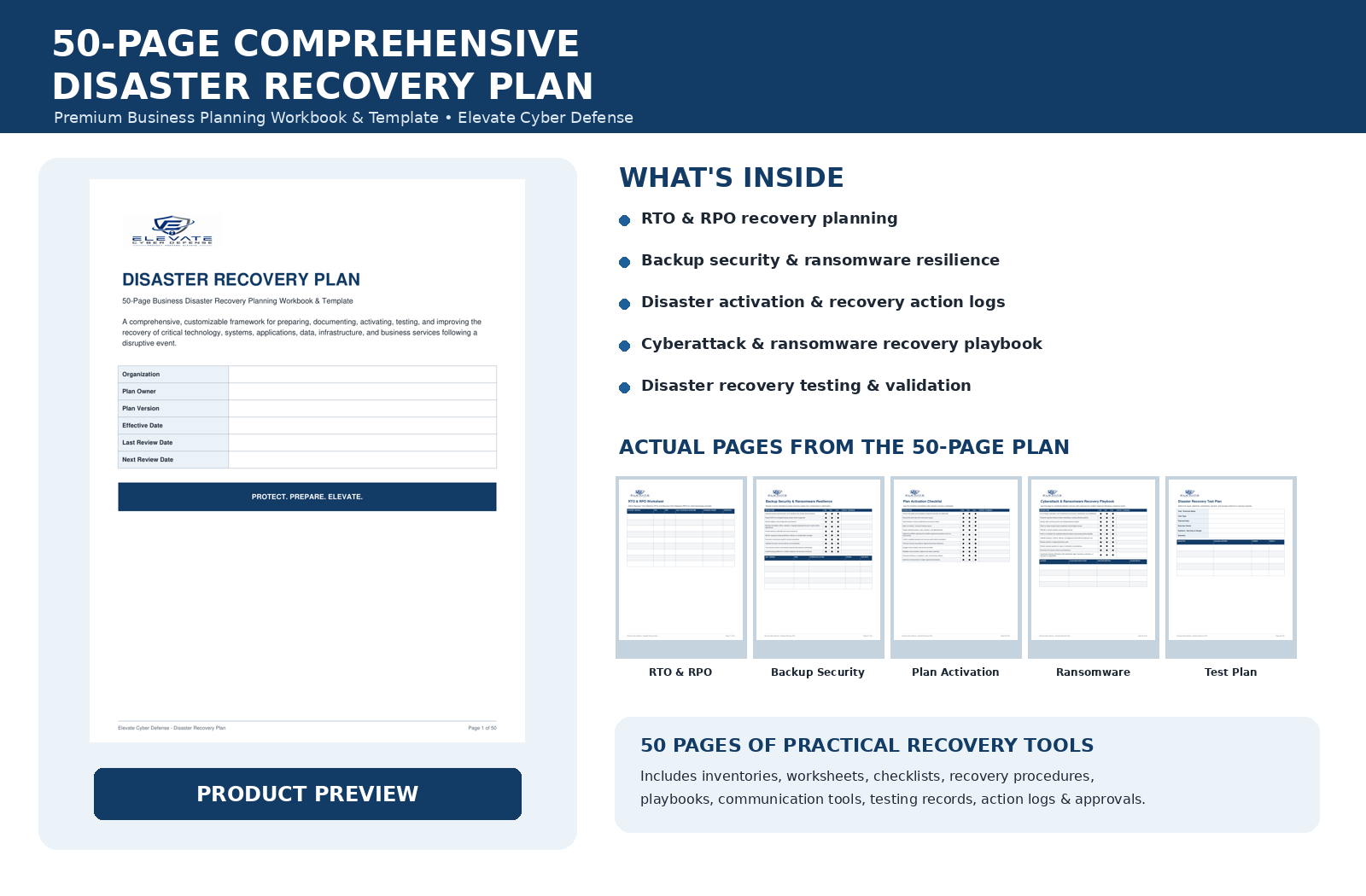
The Elevate Cyber Defense 50-Page Comprehensive Disaster Recovery Plan provides businesses with a structured, customizable framework for documenting how critical systems, applications, data, infrastructure, and technology services will be restored following a disruption.
Unlike a basic disaster recovery checklist, this comprehensive workbook guides organizations through the entire recovery process—from identifying critical systems and establishing recovery priorities to documenting backup strategies, recovery procedures, communication plans, testing, corrective actions, and final plan approval.
Disaster Recovery Plan governance and document control
Plan purpose, scope, objectives, assumptions, and constraints
Disaster recovery roles and responsibilities
Recovery team contact directory and emergency call tree
Critical Business Functions and Business Impact Analysis
Critical systems and applications inventory
Infrastructure and network inventory
Data and information asset inventory
System dependency mapping
Vendor and third-party recovery dependencies
Recovery priority classifications
Recovery Time Objective (RTO) and Recovery Point Objective (RPO) worksheets
Minimum service and recovery requirements
Backup strategy, inventory, and schedules
Backup security and ransomware resilience
Backup restoration testing records
Alternate processing and recovery locations
Replacement hardware and equipment planning
Software, licensing, and installation resources
Credential and privileged-access recovery
Disaster declaration criteria
Disaster Recovery Plan activation checklist
Initial damage and impact assessment
Recovery decision and action logs
Internal and external communication planning
Stakeholder notification templates
Cyberattack and ransomware recovery playbook
Server and virtual machine recovery procedures
Database recovery procedures
Network and connectivity recovery procedures
Cloud and SaaS recovery procedures
Endpoint and workforce recovery procedures
Email, collaboration, and identity recovery
Physical site and facility technology recovery
Power, internet, and telecommunications failure playbook
Data corruption and accidental deletion recovery
Recovery validation and acceptance checklist
Return-to-normal operations checklist
Disaster recovery testing plan
Test execution and results documentation
Lessons learned and corrective-action planning
Annual review and maintenance checklist
Final approval and plan authorization
This plan gives small businesses and growing organizations a structured way to prepare before a disaster occurs, instead of determining recovery procedures during an emergency.
Use the worksheets, checklists, inventories, recovery procedures, tracking tables, and approval sections to develop a disaster recovery strategy tailored to your organization's technology environment and operational needs.