
Security Tools & Guides
Practical cybersecurity resources designed to help you identify risks, strengthen security practices, and protect your organization.
Explore practical guides, checklists, templates, and security tools created to help businesses take meaningful steps toward stronger cybersecurity.
Explore Our Security Collection
Discover practical cybersecurity guides, checklists, templates, and toolkits designed to help organizations strengthen their security practices.
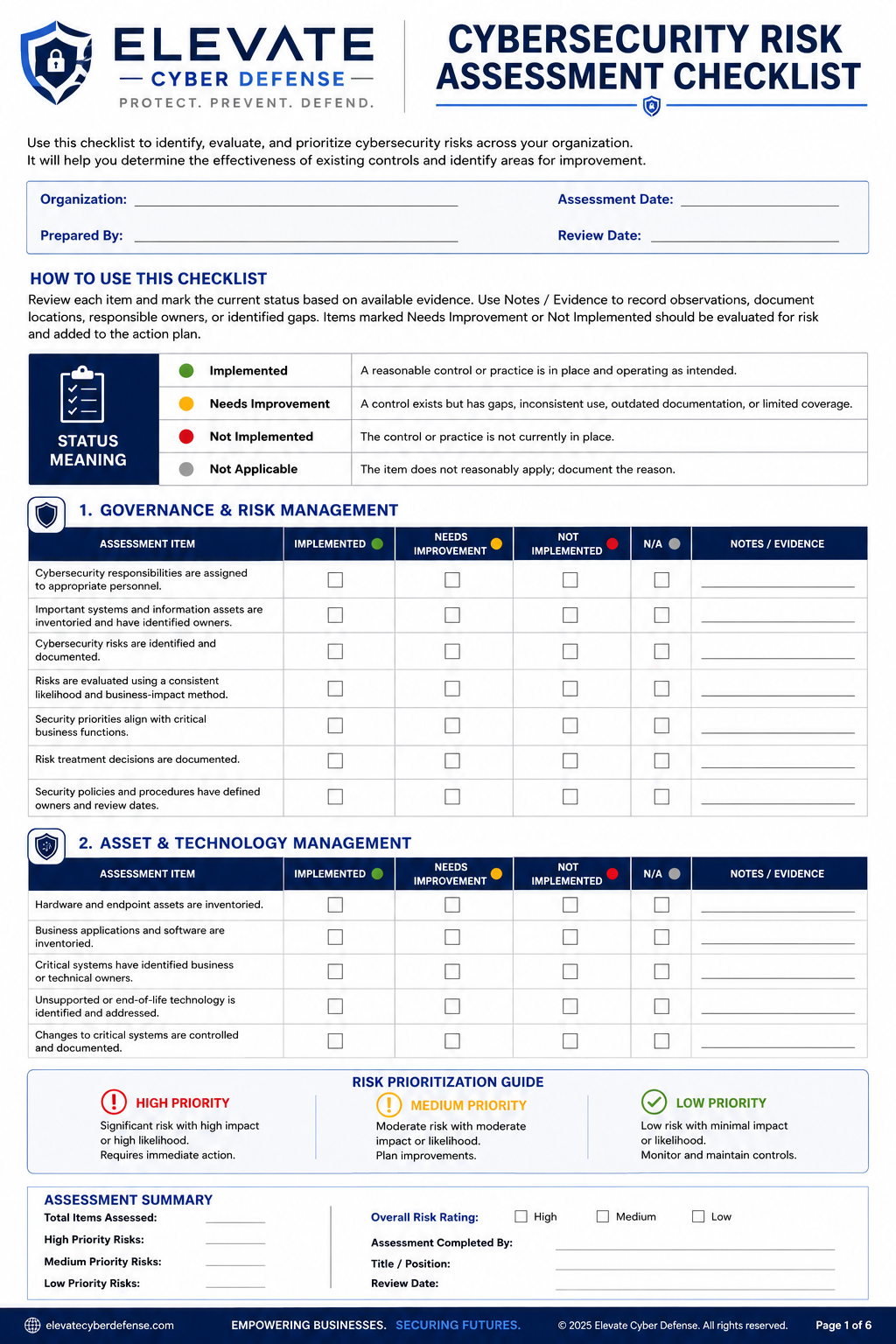
Identify, evaluate, and prioritize cybersecurity risks with a practical Cybersecurity Risk Assessment Checklist from Elevate Cyber Defense.
Designed for small businesses and organizations, this cybersecurity assessment checklist provides a structured way to review key security controls, identify areas that need improvement, document findings, prioritize risks, and plan corrective actions.
What's Included
A detailed explanation of the entire checklist, such as:
Organization & Asset Identification
Access & Account Security
Network Security
Endpoint & Device Security
Data Protection
Backup & Recovery
Employee Security
Remote Work Security
Incident Response
Business Continuity
Risk Identification
Risk Rating & Prioritization
Remediation Tracking
Assessment Summary
Who It's For:
Small businesses, business owners, managers, IT teams, security professionals, and organizations looking for a practical starting point for evaluating their cybersecurity posture.
Review the complete checklist before purchasing. This full-page preview shows the assessment structure, control categories, risk prioritization guidance, and assessment summary included with your purchase.
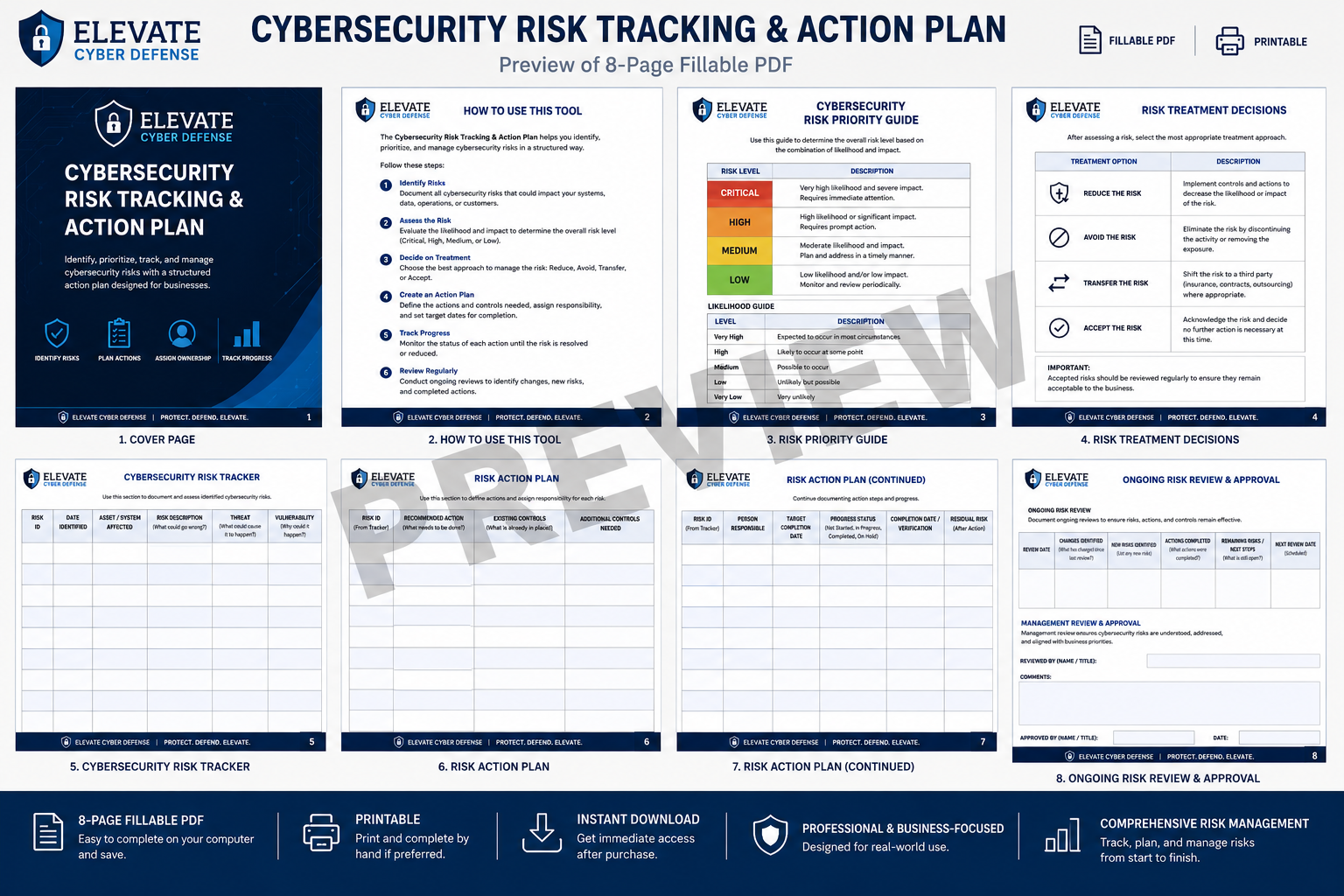
Identify, prioritize, track, and manage cybersecurity risks with a structured action plan designed for businesses.
The Cybersecurity Risk Tracking & Action Plan helps businesses document security risks, assign responsibility, prioritize corrective actions, and monitor progress toward reducing cybersecurity risk.
This practical business tool includes structured sections for:
Tracking identified cybersecurity risks
Documenting affected systems and assets
Identifying threats and vulnerabilities
Evaluating likelihood and potential impact
Prioritizing risks by severity
Assigning risk ownership
Documenting existing security controls
Creating corrective action plans
Tracking remediation progress
Recording target completion dates
Reviewing residual risk
Conducting ongoing risk reviews
Documenting management review and approval
Designed to help businesses organize cybersecurity risks and turn identified concerns into actionable security improvements.
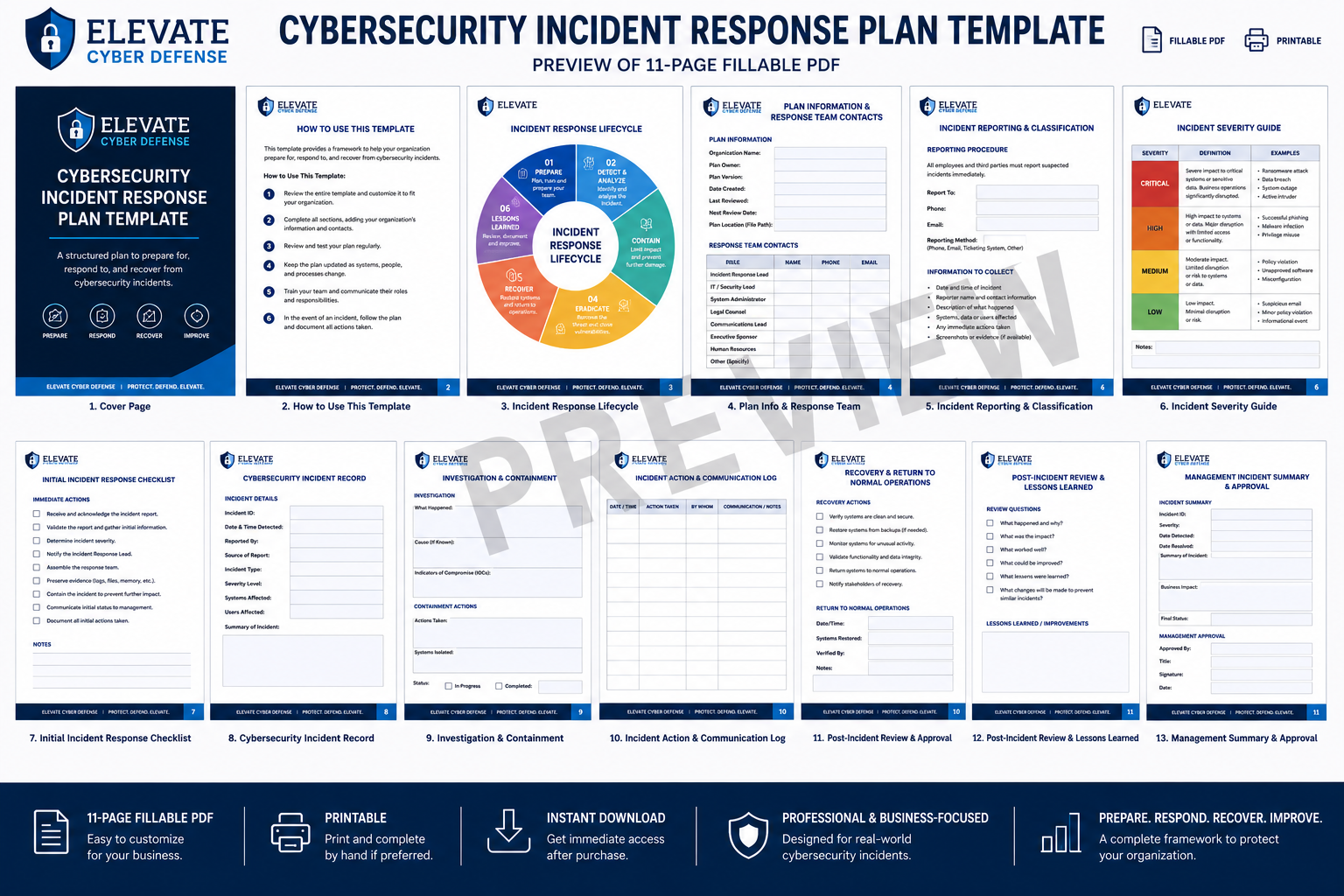
Be prepared before a cybersecurity incident happens.
The Cybersecurity Incident Response Plan Template is a practical, ready-to-use resource designed to help small businesses and organizations prepare for, document, manage, and recover from cybersecurity incidents.
This downloadable incident response plan template provides a structured framework for responding to security events from initial reporting and investigation through containment, recovery, and post-incident review.
What's Included:
Incident response planning guidance
Incident response lifecycle
Response team and contact information
Incident reporting procedures
Incident severity classification guide
Initial incident response checklist
Cybersecurity incident record
Investigation and containment documentation
Incident action and communication log
Recovery and return-to-operations planning
Post-incident review and lessons learned
Management incident summary and approval
Designed for small businesses and organizations that need a structured way to prepare for and manage cybersecurity incidents.
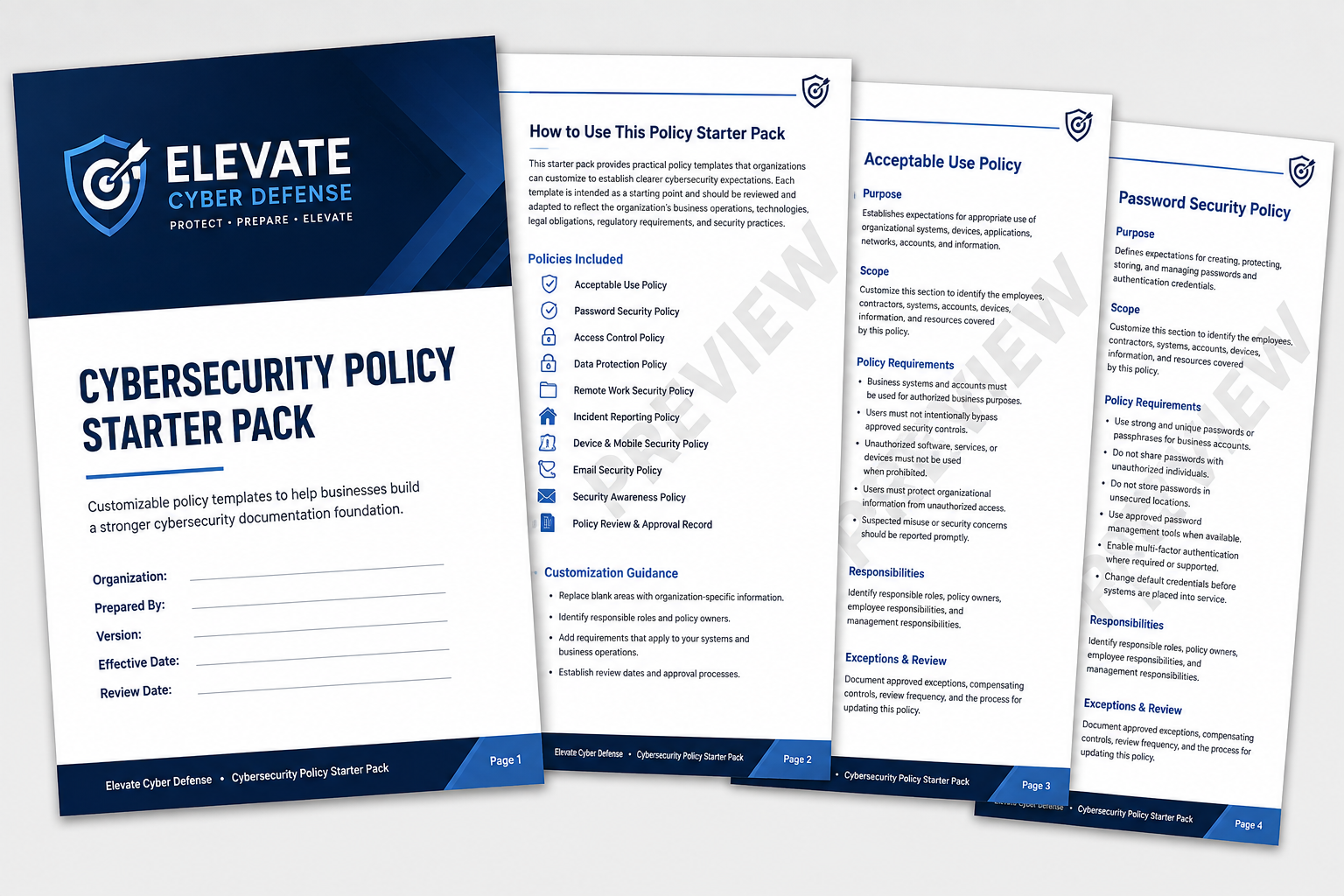
Many businesses know they need cybersecurity policies but struggle with where to start, what policies they need, or how to organize their security requirements.
The Cybersecurity Policy Starter Pack provides a practical collection of customizable policy templates designed to help businesses begin building a stronger cybersecurity documentation foundation.
These templates can help organizations establish clear expectations for employees, users, access to systems, data protection, devices, remote work, and cybersecurity responsibilities.
What's Included
This comprehensive policy pack includes customizable templates for:
✔ Acceptable Use Policy — Establish expectations for appropriate use of company systems, technology, and resources.
✔ Password Security Policy — Define requirements for protecting passwords and authentication credentials.
✔ Access Control Policy — Establish guidelines for managing user access and permissions.
✔ Data Protection Policy — Help define expectations for protecting sensitive and business information.
✔ Remote Work Security Policy — Establish cybersecurity expectations for remote and hybrid employees.
✔ Incident Reporting Policy — Define how employees should report suspected cybersecurity incidents.
✔ Device & Mobile Security Policy — Establish expectations for securing business computers, laptops, and mobile devices.
✔ Email Security Policy — Provide guidance for protecting business email and recognizing potential threats.
✔ Security Awareness Policy — Support ongoing employee cybersecurity awareness and security responsibilities.
✔ Policy Review & Approval Record — Document policy reviews, updates, approvals, and review dates.
Designed for Practical Business Use
This starter pack can help support:
Small business cybersecurity programs
Security documentation
Employee cybersecurity expectations
Internal security policies
Cybersecurity awareness programs
Employee onboarding
Remote work programs
Access management
Data protection practices
Security program development
Customize for Your Business
Each policy template is designed to be a starting point that businesses can customize based on their:
Organization size
Industry
Technology environment
Security requirements
Internal processes
Regulatory or compliance requirements
Start building a stronger cybersecurity foundation with practical policy templates designed to help your business establish clearer security expectations and documentation.
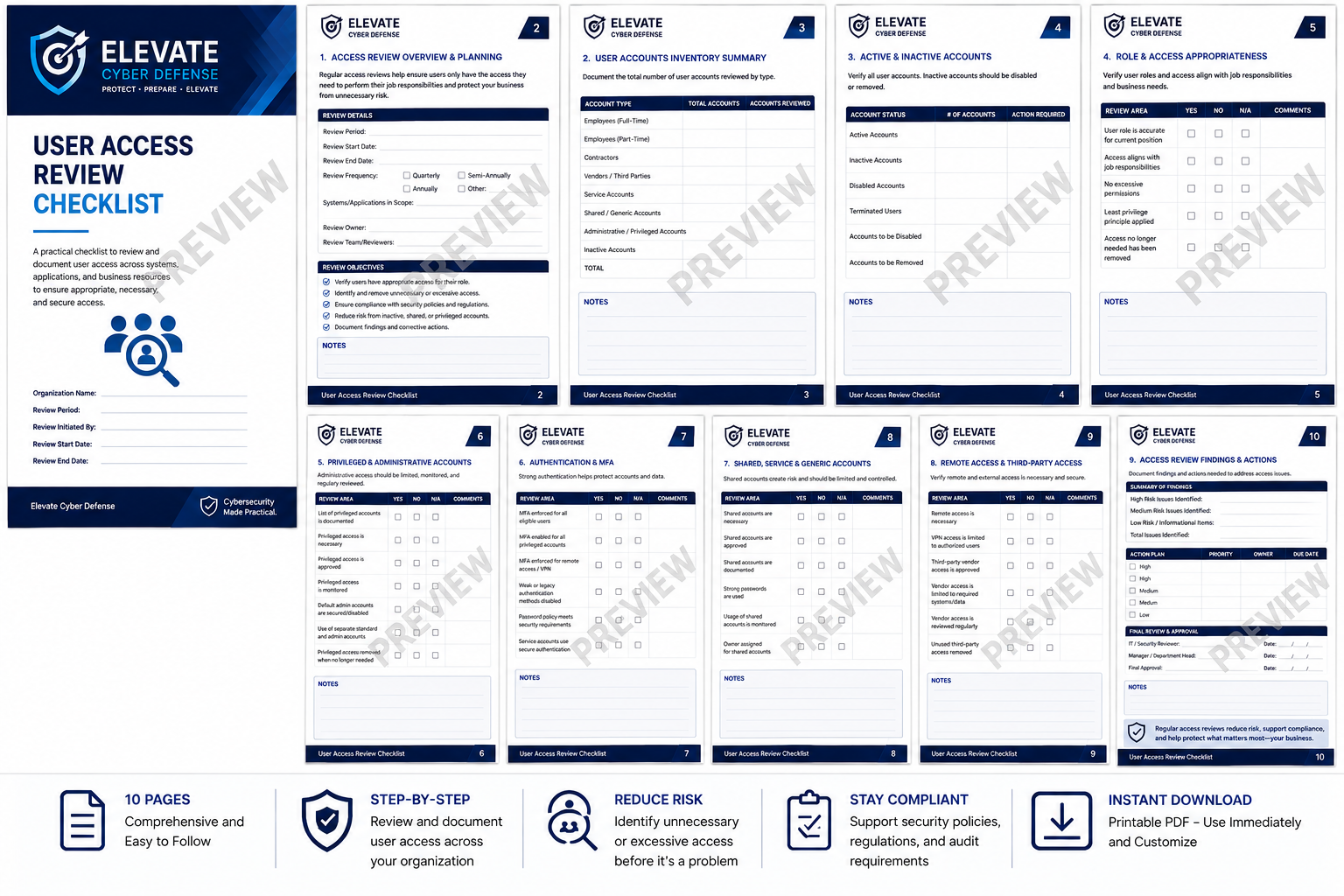
Know who has access. Verify what they need. Reduce unnecessary permissions.
The User Access Review Checklist provides small businesses with a structured, customizable way to perform periodic user access reviews and document access across systems, applications, accounts, and business information.
As employees change roles, leave the organization, gain new responsibilities, or receive access to additional systems, permissions can accumulate over time. Regular access reviews help businesses identify unnecessary, outdated, excessive, or potentially risky access before it becomes a security concern.
Use this customizable checklist to review and document:
Active and inactive user accounts
Employee and contractor access
Role and responsibility changes
Least-privilege access
Privileged and administrative accounts
Multi-factor authentication (MFA)
Shared and generic accounts
Remote access and VPN permissions
Cloud applications and business systems
Third-party and vendor access
Former employee access
Access requiring modification or removal
Corrective actions and follow-up
Final review and approval
Designed for small and growing businesses, this resource provides a practical framework for performing periodic access reviews and maintaining clearer documentation of who has access to important business systems and information.
Best For: Small businesses, business owners, IT teams, managers, security teams, and organizations looking to strengthen identity and access management practices.
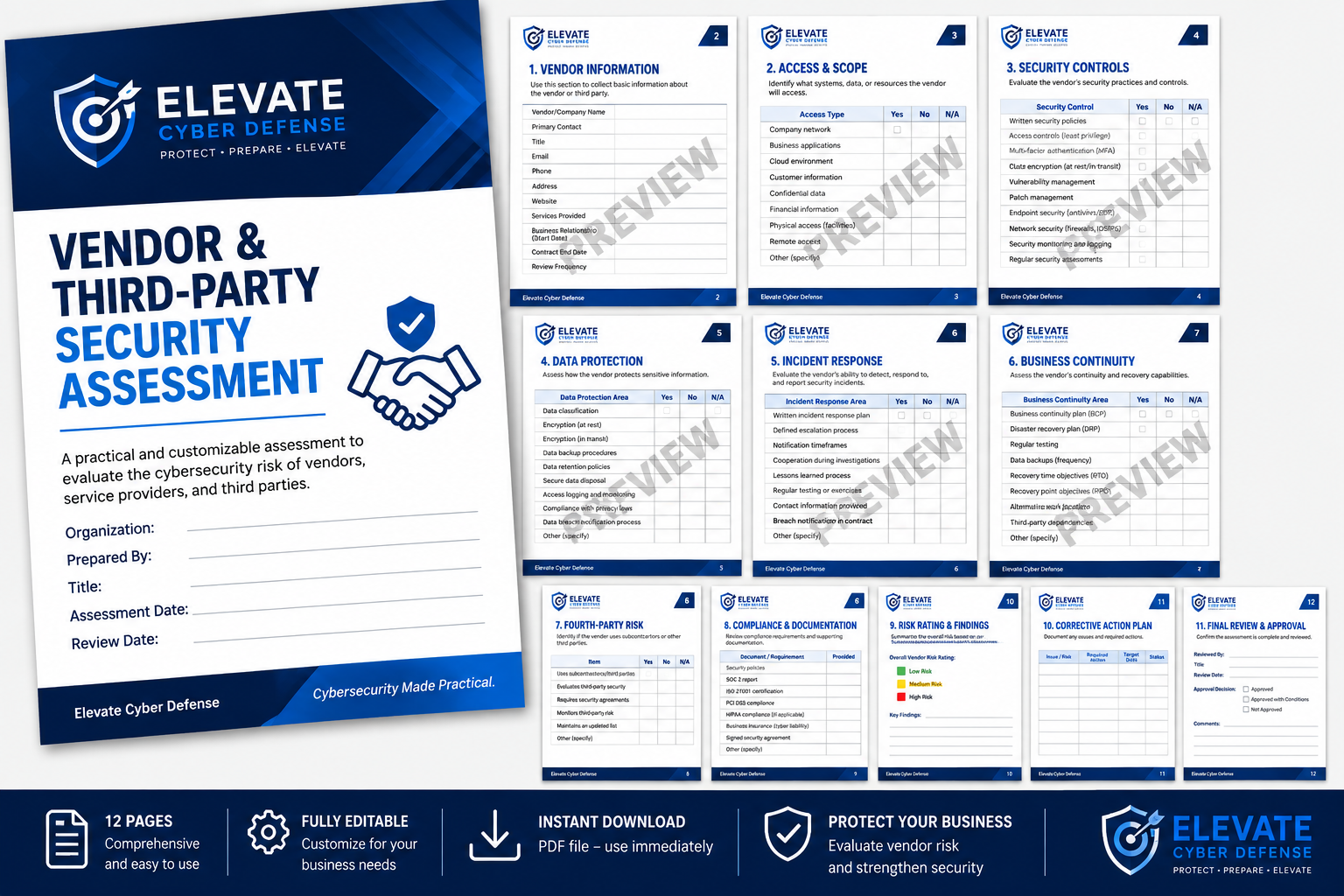
The Vendor & Third-Party Security Assessment provides businesses with a structured third-party vendor security assessment process for evaluating and documenting the cybersecurity practices of vendors, service providers, contractors, and other third parties that may access business systems, networks, applications, or sensitive information.
Third-party relationships can introduce cybersecurity risk when outside organizations have access to company data, customer information, cloud environments, business applications, or critical services. This customizable assessment helps businesses identify potential security concerns, document vendor safeguards, and make more informed decisions before establishing or continuing a third-party relationship.
Use this assessment to evaluate and document:
Vendor and third-party information
Services provided and business relationship
Access to company systems, applications, and networks
Access to sensitive, confidential, or customer information
User access controls and least-privilege practices
Password and multi-factor authentication (MFA) protections
Data protection, encryption, storage, and transmission
Security policies and cybersecurity practices
Vulnerability and patch management
Endpoint and network security
Cybersecurity incident response and notification procedures
Business continuity, disaster recovery, and backup practices
Subcontractor and fourth-party relationships
Security awareness and employee practices
Compliance and supporting documentation
Identified security concerns and required corrective actions
Overall vendor risk rating
Final review, approval, and reassessment requirements
Designed for small and growing businesses, this resource provides a practical framework for evaluating third-party cybersecurity risk before onboarding a new vendor and during periodic reviews of existing vendor relationships.
Best For: Small businesses, business owners, IT teams, managers, security teams, and organizations that rely on vendors, contractors, cloud providers, technology providers, or other third parties.

The Device & Endpoint Security Checklist provides businesses with a structured way to review and document the cybersecurity protections applied to computers, laptops, mobile devices, and other endpoints used to access business systems and information.
Business devices are frequent targets for malware, ransomware, credential theft, unauthorized access, and other cybersecurity threats. Security gaps such as outdated software, excessive administrator privileges, missing encryption, unapproved applications, or poorly protected mobile devices can increase an organization's exposure to cyber incidents.
Use this customizable checklist to review and document:
Business device and endpoint inventory
Company-owned and personally owned devices
Operating system and software updates
Security patch management
Antivirus and endpoint protection
Firewall configuration and protection
Device and disk encryption
Password and multi-factor authentication (MFA)
User accounts and administrator privileges
Automatic screen locking
Approved software and applications
Unauthorized software
USB devices and removable media
Mobile-device security
Remote and off-site devices
Lost or stolen device procedures
Endpoint monitoring and security alerts
Secure device reassignment and disposal
Identified security gaps and corrective actions
Final endpoint security review and approval
Designed for small and growing businesses, this resource provides a practical framework for strengthening endpoint security and documenting the safeguards used to protect the devices employees rely on to access business systems, applications, networks, and sensitive information.
Best For: Small businesses, business owners, IT teams, managers, security teams, remote and hybrid organizations, and businesses looking to improve computer, laptop, mobile-device, and endpoint security.
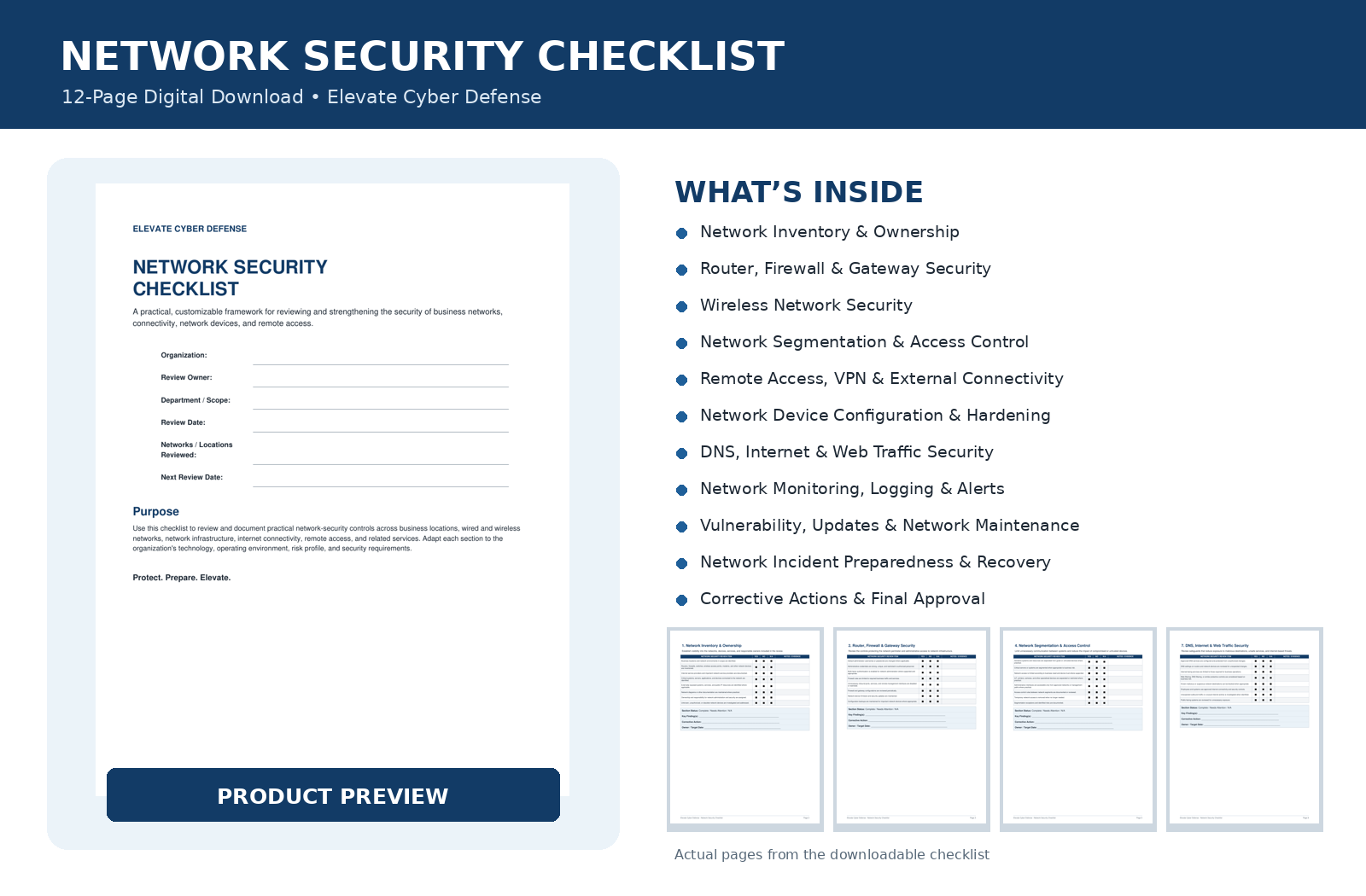
The Elevate Cyber Defense Network Security Checklist provides businesses with a comprehensive framework for reviewing network security best practices and evaluating the security of networks, network devices, wireless connections, remote access, and supporting infrastructure.
This customizable 12-page checklist helps organizations identify security gaps, document findings, assign corrective actions, and establish responsibility for improving network security.
This checklist covers:
Network inventory and ownership
Router, firewall, and gateway security
Wireless network and Wi-Fi security
Network segmentation and access control
Remote access, VPN, and external connectivity
Network device configuration and hardening
DNS, internet, and web traffic security
Network monitoring, logging, and alerts
Vulnerability management, updates, and network maintenance
Network incident preparedness and recovery
Findings and corrective-action tracking
Final security review and approval
Designed for small businesses and organizations that need a practical way to evaluate their network-security practices without starting from scratch.
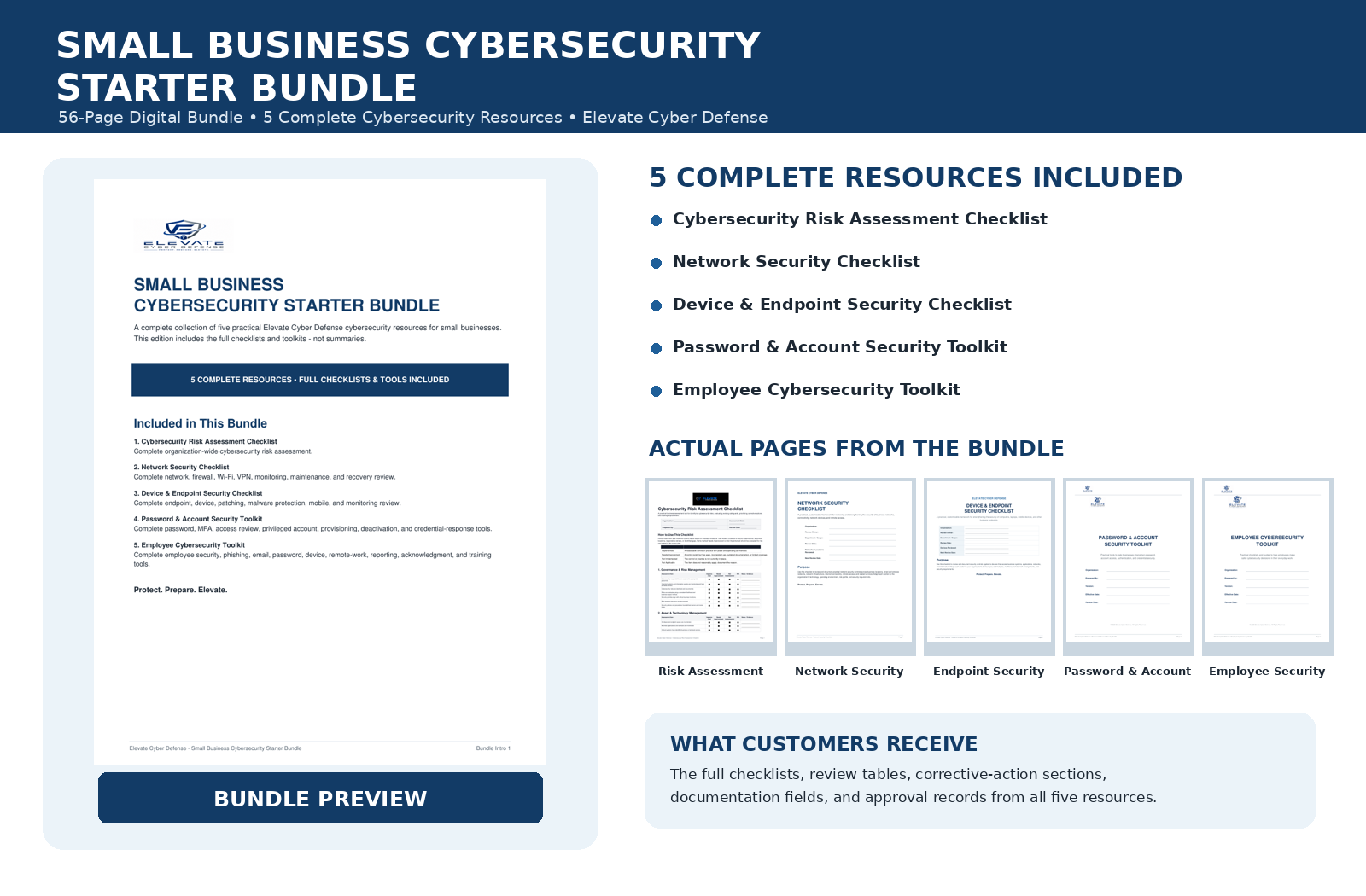
Build a stronger cybersecurity foundation for your business with five practical security tools in one complete starter bundle.
The Elevate Cyber Defense Small Business Cybersecurity Starter Bundle is designed to help small businesses identify cybersecurity risks, strengthen their networks and devices, improve account security, and establish better employee security practices.
Instead of starting from scratch, this bundle provides practical, ready-to-use cybersecurity checklists and toolkits that can be incorporated into your organization's existing security processes.
This bundle includes:
Cybersecurity Risk Assessment Checklist — Identify potential cybersecurity risks, vulnerabilities, and areas requiring improvement.
Network Security Checklist — Review firewalls, routers, Wi-Fi, remote access, network monitoring, segmentation, and other network-security controls.
Device & Endpoint Security Checklist — Evaluate computers, laptops, mobile devices, updates, patching, malware protection, and endpoint-security practices.
Password & Account Security Toolkit — Strengthen passwords, MFA, user accounts, privileged access, account reviews, and credential-security practices.
Employee Cybersecurity Toolkit — Help employees recognize threats and follow safer practices for email, phishing, passwords, devices, remote work, and incident reporting.
Designed to Help Your Business
Use these resources to identify security gaps, document findings, assign corrective actions, strengthen everyday cybersecurity practices, and create a more organized approach to protecting your business.
Ideal for small businesses, startups, growing organizations, and business owners who need practical cybersecurity resources without having to develop everything from the ground up.
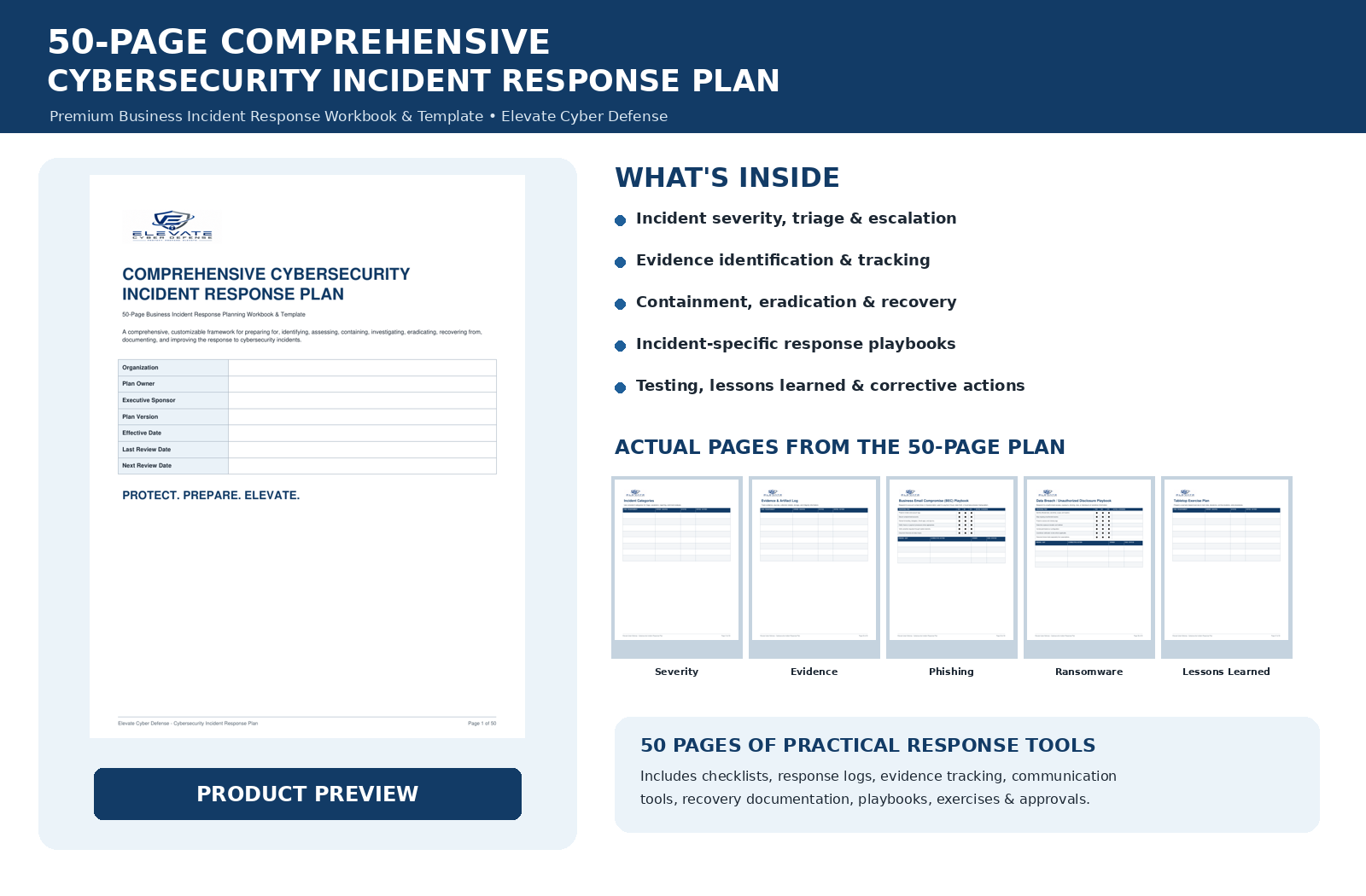
The Elevate Cyber Defense 50-Page Comprehensive Cybersecurity Incident Response Plan provides businesses with a structured, customizable framework for preparing for, identifying, managing, containing, investigating, and recovering from cybersecurity incidents.
Rather than trying to determine what to do during an active security event, this comprehensive plan helps organizations establish roles, responsibilities, escalation procedures, response processes, documentation requirements, communication procedures, and incident-specific response actions before an incident occurs.
This Comprehensive Plan Covers:
Incident response plan governance and document control
Incident response team roles and responsibilities
Emergency contact and escalation information
Cybersecurity incident identification and reporting
Incident intake and initial assessment
Incident classification and severity levels
Incident prioritization and escalation
Response activation procedures
Incident investigation and documentation
Evidence identification and handling
Incident timeline and activity tracking
Incident decision logs
Containment planning and actions
Short-term and long-term containment
Threat eradication procedures
System and account recovery
Recovery validation and monitoring
Internal communication procedures
Employee incident notifications
Customer and stakeholder communication planning
Vendor and third-party coordination
Legal, regulatory, contractual, and insurance notification review
Cybersecurity incident reporting documentation
Phishing incident response
Business Email Compromise (BEC) response
Compromised account and credential response
Malware incident response
Ransomware incident response
Data breach and unauthorized disclosure response
Lost or stolen device response
Insider threat response
Cloud and SaaS security incident response
Network security incident response
Third-party and vendor incident response
Denial-of-service and service disruption response
Incident evidence and artifact tracking
Affected system and account tracking
Incident containment checklist
Incident recovery checklist
Post-incident review
Root-cause analysis
Lessons learned
Corrective-action tracking
Incident response testing and tabletop exercises
Plan maintenance and annual review
Final management review and approval
Built for Practical Business Use
The plan is designed to give businesses a repeatable incident-response process instead of relying on improvised decisions during a cybersecurity emergency.
The included worksheets, checklists, response procedures, tracking logs, documentation fields, and incident-specific playbooks can be customized to match your organization's technology environment, employees, vendors, operations, and cybersecurity risks.
Ideal for small businesses, growing organizations, IT teams, business owners, and organizations developing or strengthening their cybersecurity preparedness.
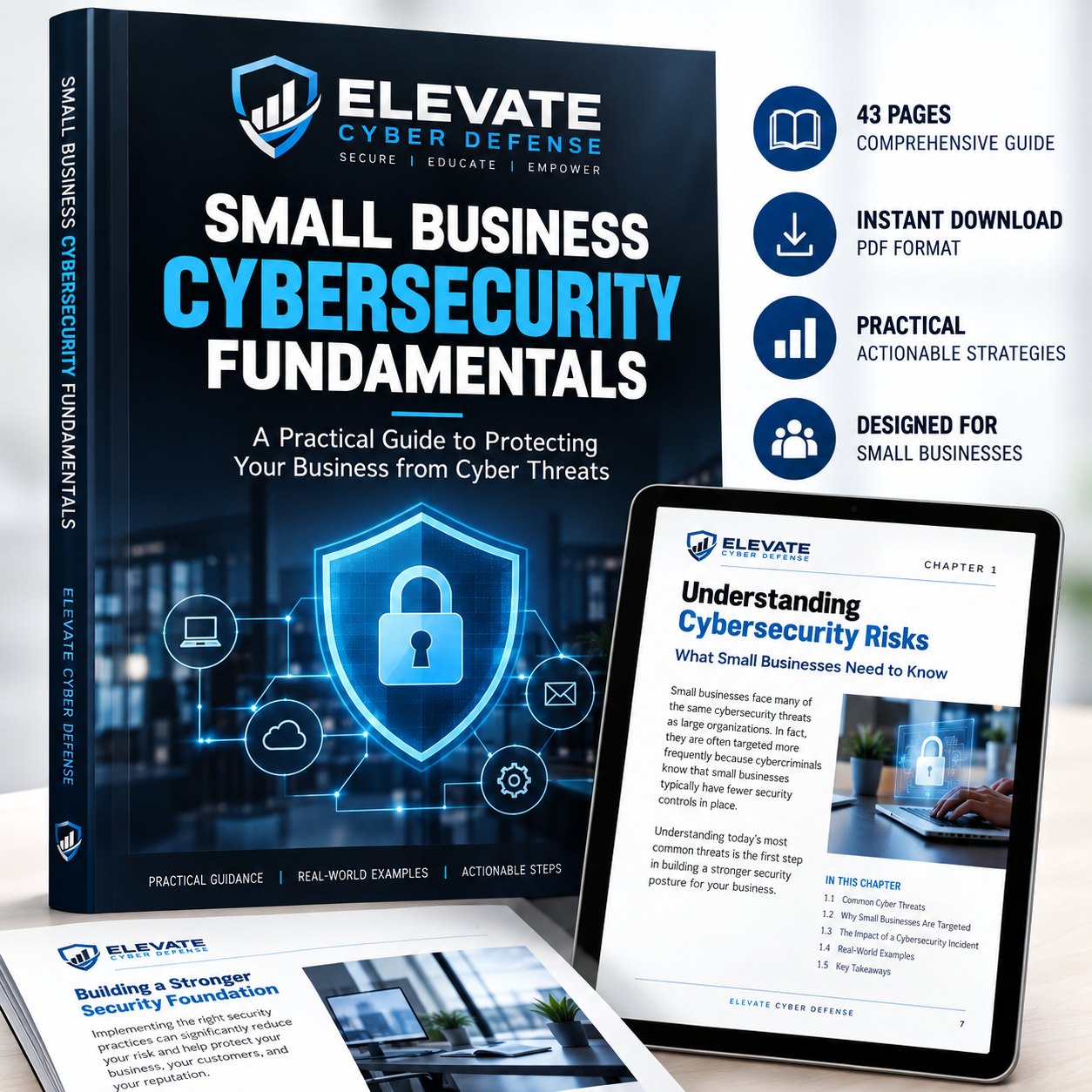
A Practical Guide to Protecting Your Business from Cyber Threats
Cybersecurity is essential for businesses of every size. Small businesses face growing risks from phishing attacks, ransomware, unauthorized access, data breaches, and other security threats. Without the right safeguards, a single cybersecurity incident can disrupt operations, expose sensitive information, and result in financial losses.
The Small Business Cybersecurity Fundamentals eBook from Elevate Cyber Defense is a comprehensive 43-page guide designed to help small-business owners, managers, and employees understand cybersecurity risks and take practical steps to strengthen their organization's security.
Written in clear, easy-to-understand language, this guide provides actionable recommendations, real-world examples, and step-by-step guidance to help businesses build stronger cybersecurity practices without requiring advanced technical knowledge.
What's Included
Understanding common cybersecurity threats and business risks
Building a practical small-business security program
Protecting passwords, accounts, and user access
Recognizing phishing attacks and social engineering
Securing computers, mobile devices, and business networks
Protecting sensitive business and customer information
Managing cloud services and third-party security risks
Preparing for ransomware attacks and data loss
Developing incident response and recovery procedures
Strengthening business continuity and disaster recovery
Creating cybersecurity policies and documentation
Following a practical 30-day cybersecurity improvement roadmap
Evaluating cybersecurity investments and measuring progress
Who Is This eBook for?
This guide is ideal for small-business owners, entrepreneurs, office managers, startups, and organizations looking to improve cybersecurity awareness and establish stronger security practices.
Why Choose This Guide?
Cybersecurity doesn't have to be complicated or expensive. This eBook focuses on practical, manageable security improvements that small businesses can implement to reduce risks, protect important information, and prepare for potential security incidents.
Protect Your Business. Strengthen Your Security. Build Cyber Confidence.
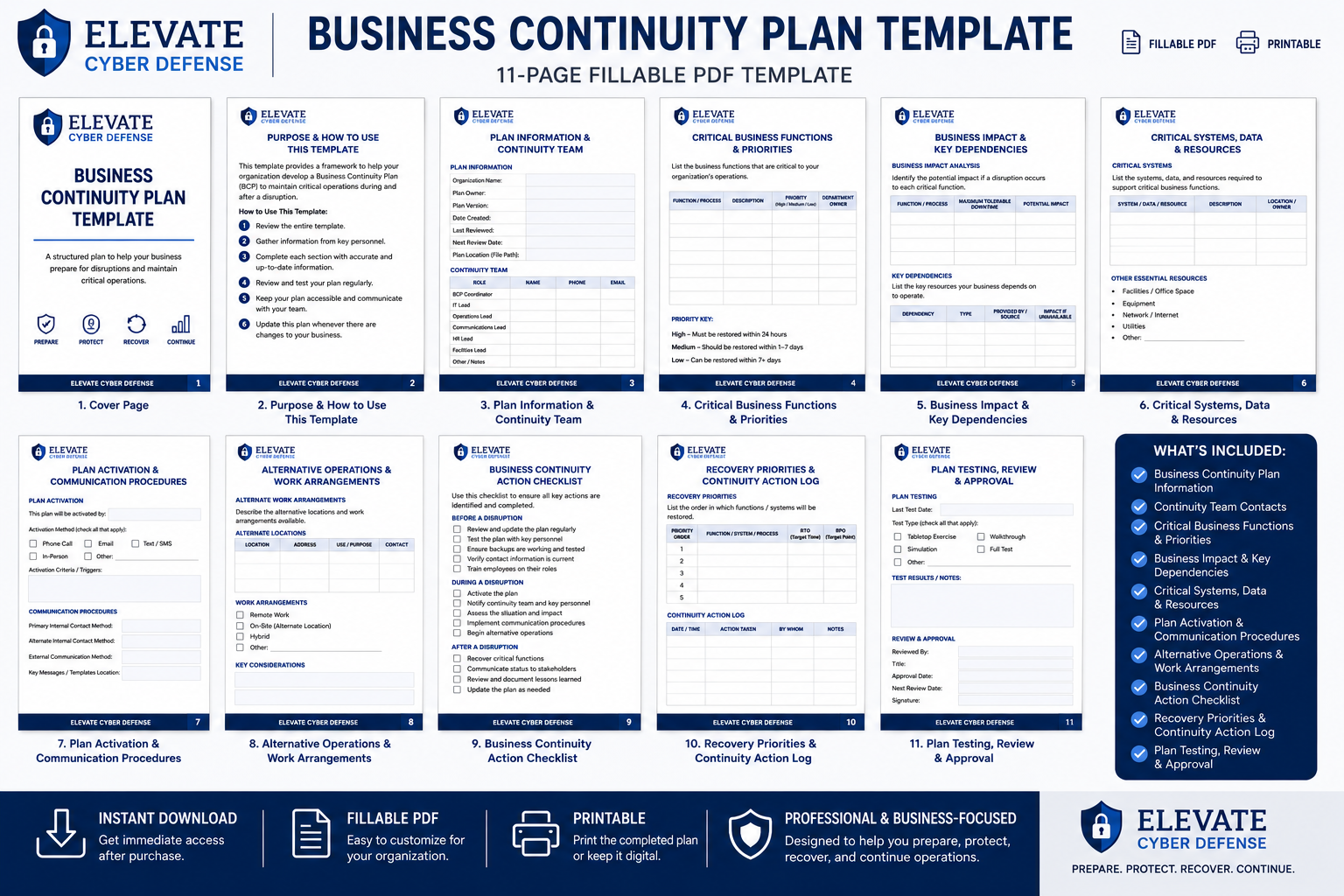
The Business Continuity Plan Template is a practical, structured tool designed to help businesses prepare for unexpected disruptions that could affect normal operations.
Whether the disruption involves a cybersecurity incident, technology outage, natural disaster, facility issue, vendor disruption, or another unexpected event, this template helps organizations identify critical business functions, plan for operational continuity, and establish recovery priorities.
What's Included:
Business Continuity Plan information
Business Continuity Team contacts
Critical Business Functions and Priorities
Business Impact Assessment
Key Dependencies
Critical Systems, Data, and Resources
Data Backup and Recovery considerations
Plan Activation procedures
Communication procedures
Alternative Work Arrangements
Temporary Operating Procedures
Business Continuity Action Checklist
Recovery Priorities
Continuity Action Log
Plan Testing, Review, and Approval
This template is designed to provide businesses with a clear starting point for organizing continuity planning and preparing for disruptions that could impact operations.
Your employees can be one of your greatest cybersecurity strengths—or one of your greatest vulnerabilities.
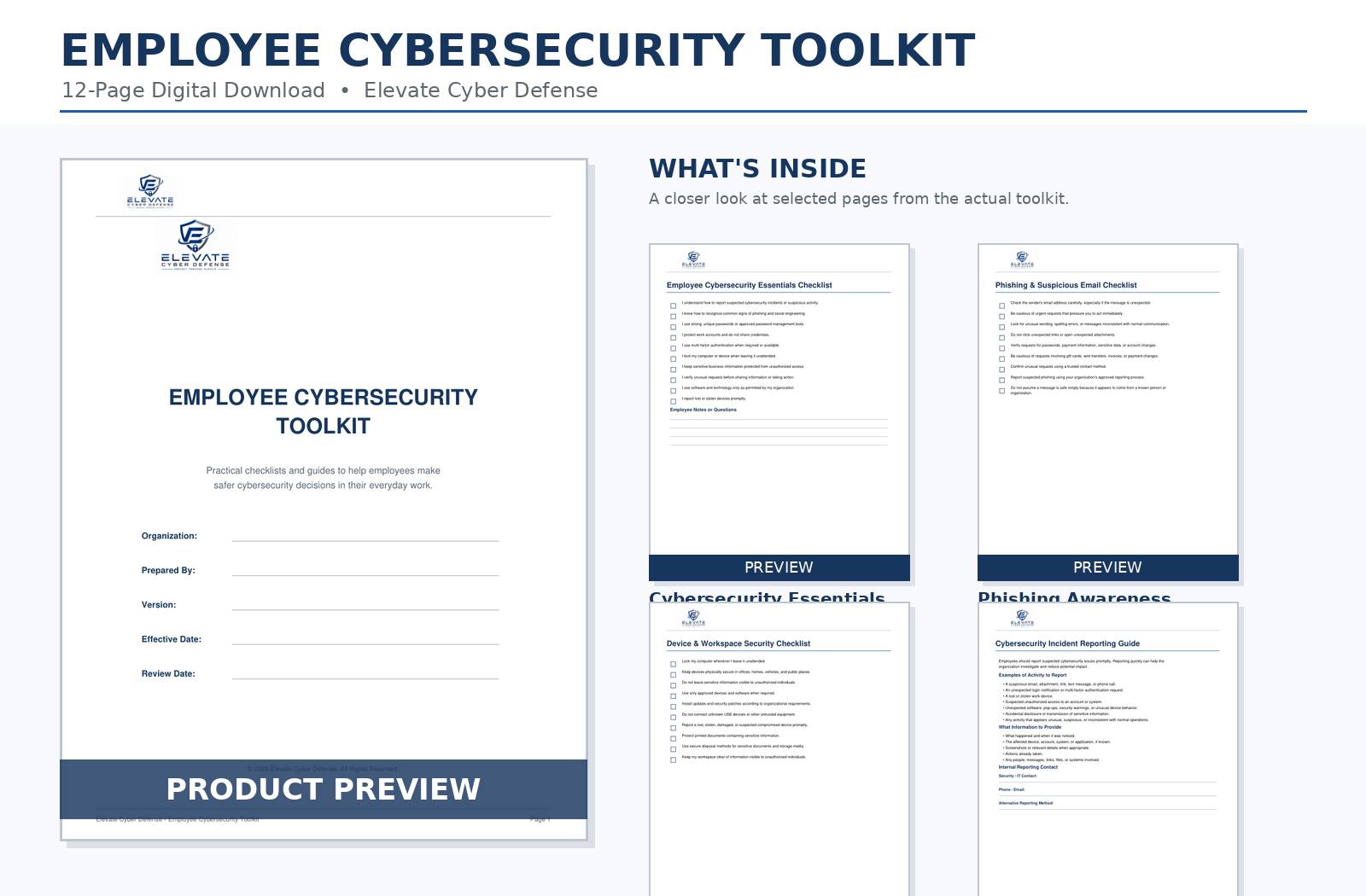
The Employee Cybersecurity Toolkit gives businesses practical, easy-to-use resources designed to help employees recognize cybersecurity threats, protect company information, and make safer decisions during their everyday work.
Cybersecurity awareness shouldn't be limited to a single annual training session. Employees regularly encounter suspicious emails, phishing attempts, password requests, unexpected links, account notifications, and other potential security risks. This toolkit provides structured checklists and guidance that organizations can use to reinforce important cybersecurity practices.
What's Inside
The toolkit includes 10 practical employee-focused cybersecurity resources, including:
Employee Cybersecurity Essentials Checklist — Covers foundational cybersecurity responsibilities and everyday security practices.
Phishing & Suspicious Email Checklist — Helps employees recognize warning signs and respond appropriately to suspicious messages.
Email Security Practices — Provides guidance for safely sending, receiving, and handling business emails.
Password & Account Security Checklist — Helps reinforce stronger password, account, and multi-factor authentication practices.
Device & Workspace Security Checklist — Covers physical device security and protecting information in the workplace.
Remote Work Security Checklist — Helps employees maintain secure practices while working remotely.
Safe Internet & Browsing Practices — Provides guidance for recognizing potentially unsafe websites, downloads, and online activity.
Cybersecurity Incident Reporting Guide — Helps employees understand what types of security concerns should be reported and what information to provide.
Employee Security Acknowledgment
Manager Review & Training Record
The documents are designed to be customizable, allowing businesses to add their own policies, procedures, reporting contacts, technologies, and security requirements.
Weak passwords and poorly managed accounts can create unnecessary cybersecurity risks for any business. From unauthorized access and compromised credentials to excessive permissions and forgotten accounts, password and account security requires more than simply telling employees to use strong passwords.
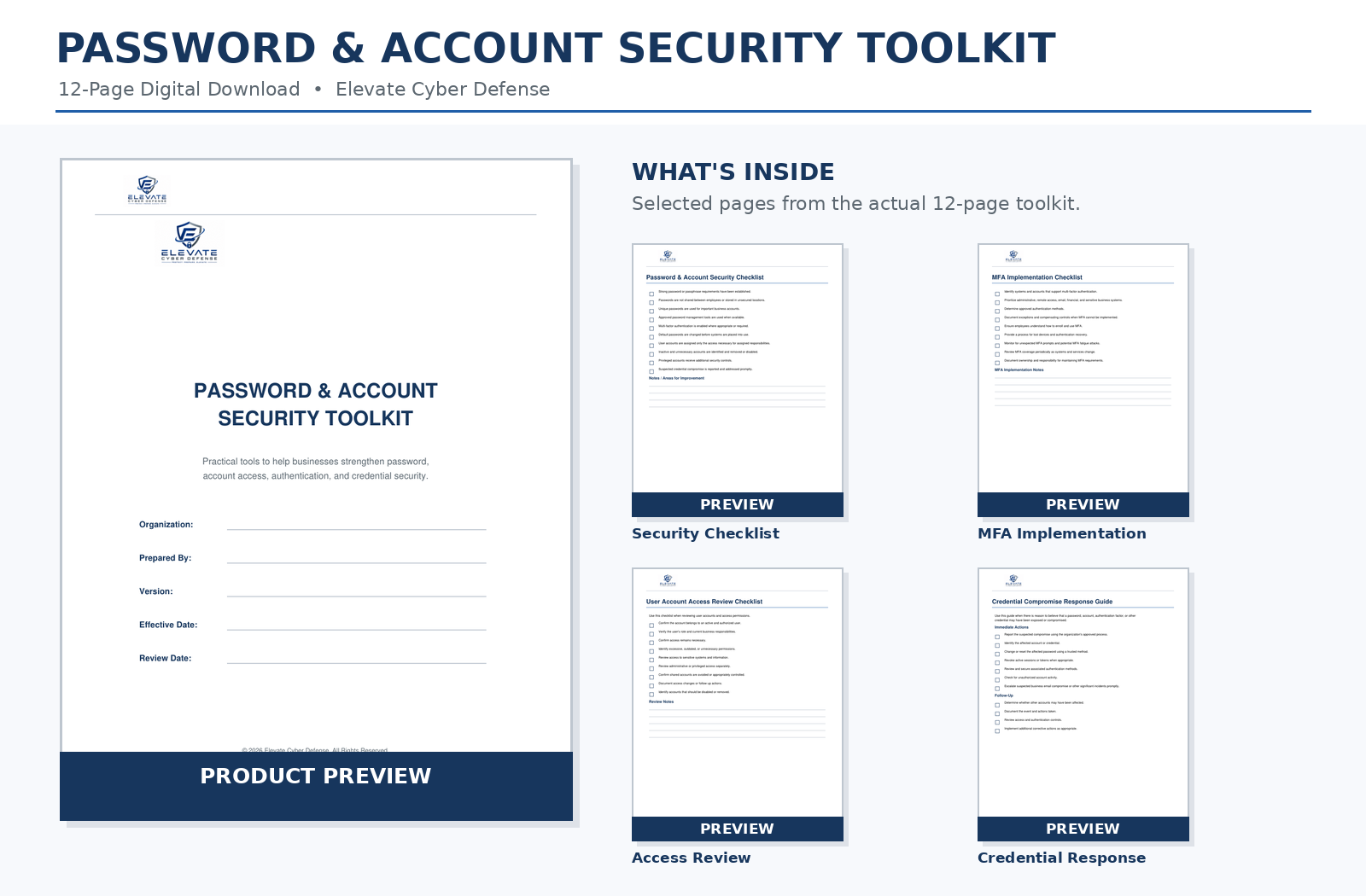
The Password & Account Security Toolkit gives businesses practical, customizable tools to help strengthen how passwords, user accounts, access permissions, and authentication are managed.
Designed for small businesses and organizations, this toolkit provides structured checklists, planning tools, and templates that can help identify security gaps and support more consistent account security practices.
This 12-page toolkit includes practical resources covering:
✔ Password & Account Security Checklist — Review foundational password and account security practices.
✔ Password Security Policy Template — Create or customize expectations for password creation, storage, sharing, and recovery.
✔ Multi-Factor Authentication (MFA) Implementation Checklist — Identify important systems and accounts that should be protected with additional authentication.
✔ Privileged Account Security Checklist — Help strengthen controls around administrator and high-level access.
✔ User Account Access Review Checklist — Review existing accounts and identify unnecessary or excessive access.
✔ New Account & Access Provisioning Checklist — Support a more structured process when creating new user accounts.
✔ Account Deactivation Checklist — Help ensure access is reviewed and removed when it is no longer needed.
✔ Credential Compromise Response Guide — Provide practical steps to follow when a password or account may have been compromised.
✔ Password & Account Security Action Plan — Document security gaps, planned improvements, responsible individuals, and target dates.
✔ Security Review & Approval Record — Keep track of toolkit reviews and updates.
Designed for Practical Business Use
This toolkit can support:
Password and credential security
User account management
Multi-factor authentication implementation
Access reviews
Employee onboarding and offboarding
Privileged account security
Internal cybersecurity assessments
Security improvement planning
The documents are designed to be customizable, allowing businesses to adapt them to their own systems, technologies, policies, and security requirements.
Give your business practical tools to better manage passwords, accounts, access, and authentication—before weak credentials become a security problem.
Employees working from home, traveling, or accessing company systems outside the office may use home networks, personal workspaces, mobile devices, cloud applications, and remote access tools. Without clear security practices, these environments can increase the risk of unauthorized access, phishing attacks, lost devices, insecure networks, and exposure of sensitive business information.
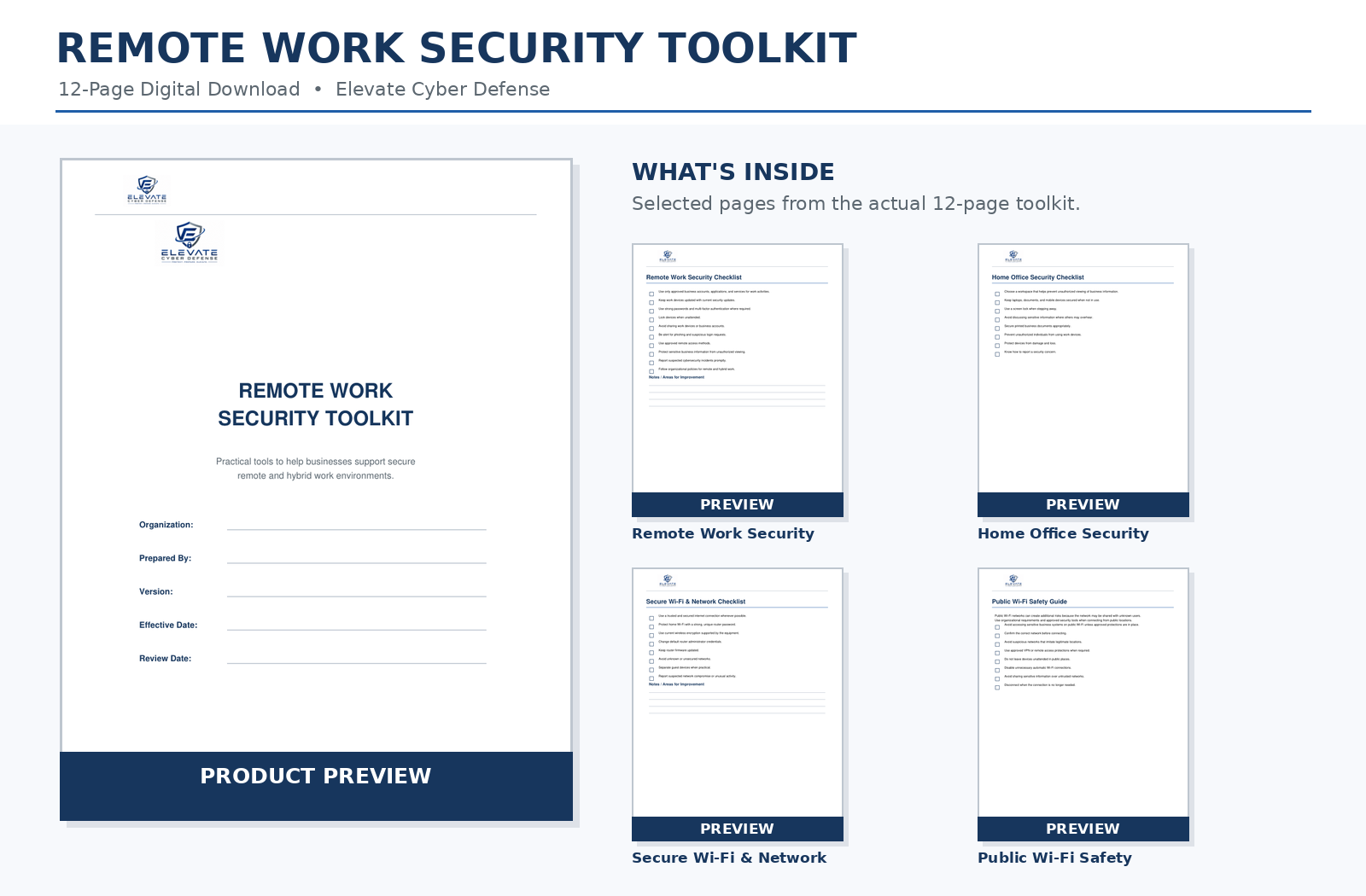
The Remote Work Security Toolkit gives businesses practical, easy-to-use resources to help establish and reinforce stronger cybersecurity practices for remote and hybrid employees.
Rather than relying on general cybersecurity advice, this toolkit provides structured checklists, guidance, and planning tools that businesses can customize to support their own remote work security requirements.
What's Inside
This comprehensive toolkit includes practical resources designed to address key areas of remote work security:
✔ Remote Work Security Checklist — Review essential cybersecurity practices for employees working outside the office.
✔ Home Office Security Checklist — Help employees create a safer and more secure workspace.
✔ Remote Device Security Checklist — Strengthen the protection of laptops, computers, and other work devices.
✔ Secure Wi-Fi & Network Checklist — Identify important practices for protecting home and remote internet connections.
✔ Remote Access & VPN Checklist — Support safer access to business systems and resources.
✔ Remote Employee Security Guidelines — Provide clear cybersecurity expectations for remote and hybrid employees.
✔ Public Wi-Fi Safety Guide — Help employees understand the risks of using public networks.
✔ Lost or Stolen Device Response Checklist — Provide practical steps for responding quickly when a work device is lost or stolen.
✔ Remote Work Security Action Plan — Identify security gaps, planned improvements, responsibilities, and target dates.
✔ Manager Review & Security Record — Document security reviews, training, and follow-up actions.
Designed for Practical Business Use
The Remote Work Security Toolkit can support:
Remote and hybrid work programs
Employee cybersecurity awareness
Home office security
Remote access security
Device protection
Wi-Fi and network security
Employee onboarding
Security training
Internal cybersecurity assessments
Help your employees work remotely with greater confidence while supporting stronger cybersecurity practices across your organization.
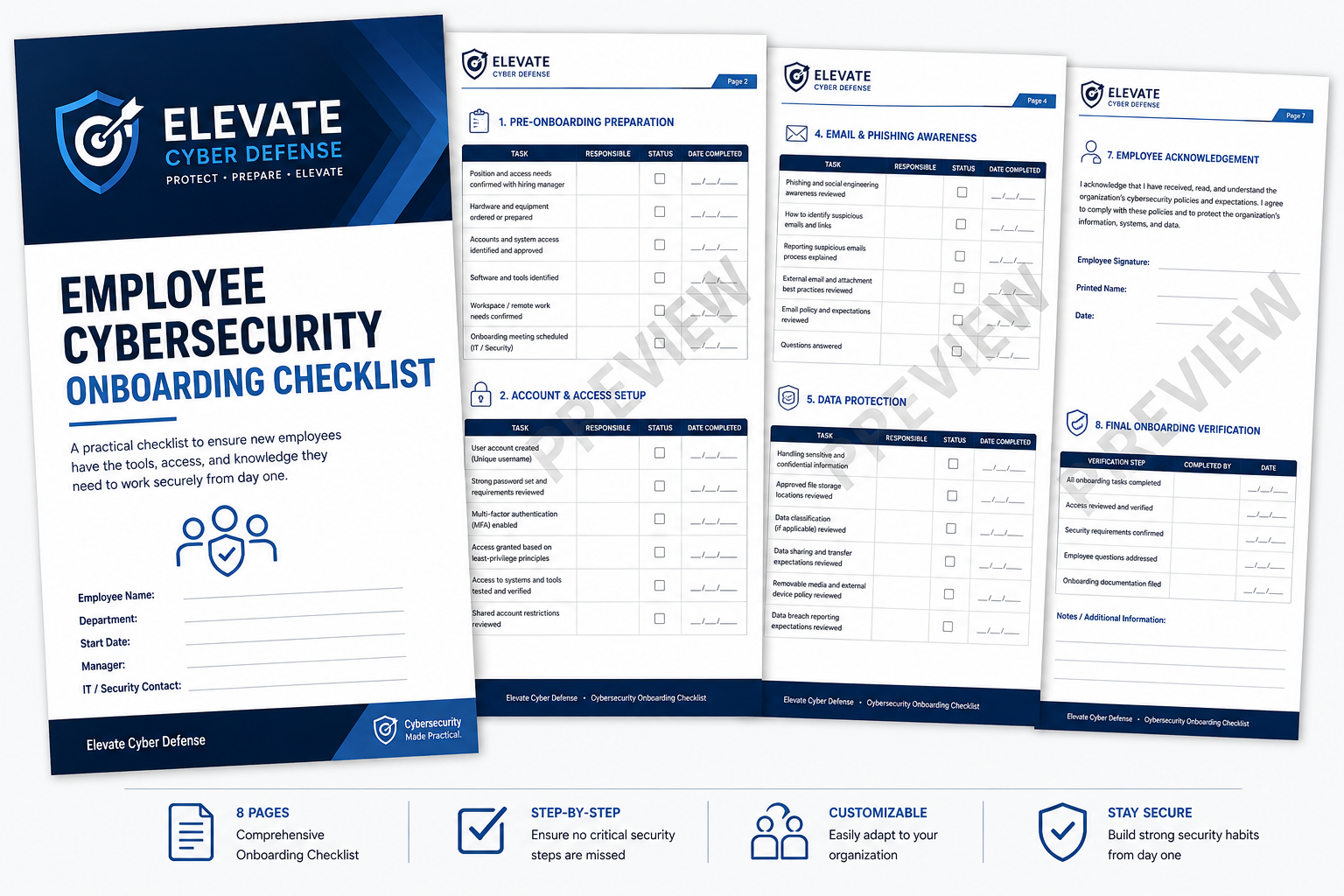
The Employee Cybersecurity Onboarding Checklist provides businesses with a practical, organized way to incorporate essential cybersecurity steps into the employee onboarding process. From account and access setup to device security and cybersecurity awareness, this checklist helps ensure important security tasks aren't overlooked when a new employee joins your organization.
Use this customizable checklist to document and track key onboarding activities, including:
Account and system access setup
Password and multi-factor authentication requirements
Device and workstation security
Email and phishing awareness
Data protection responsibilities
Remote work security
Cybersecurity policy acknowledgement
Security awareness and reporting procedures
Final onboarding verification
Designed with small and growing businesses in mind, this resource provides a straightforward framework that can be adapted to your organization's technology, policies, employees, and security requirements.
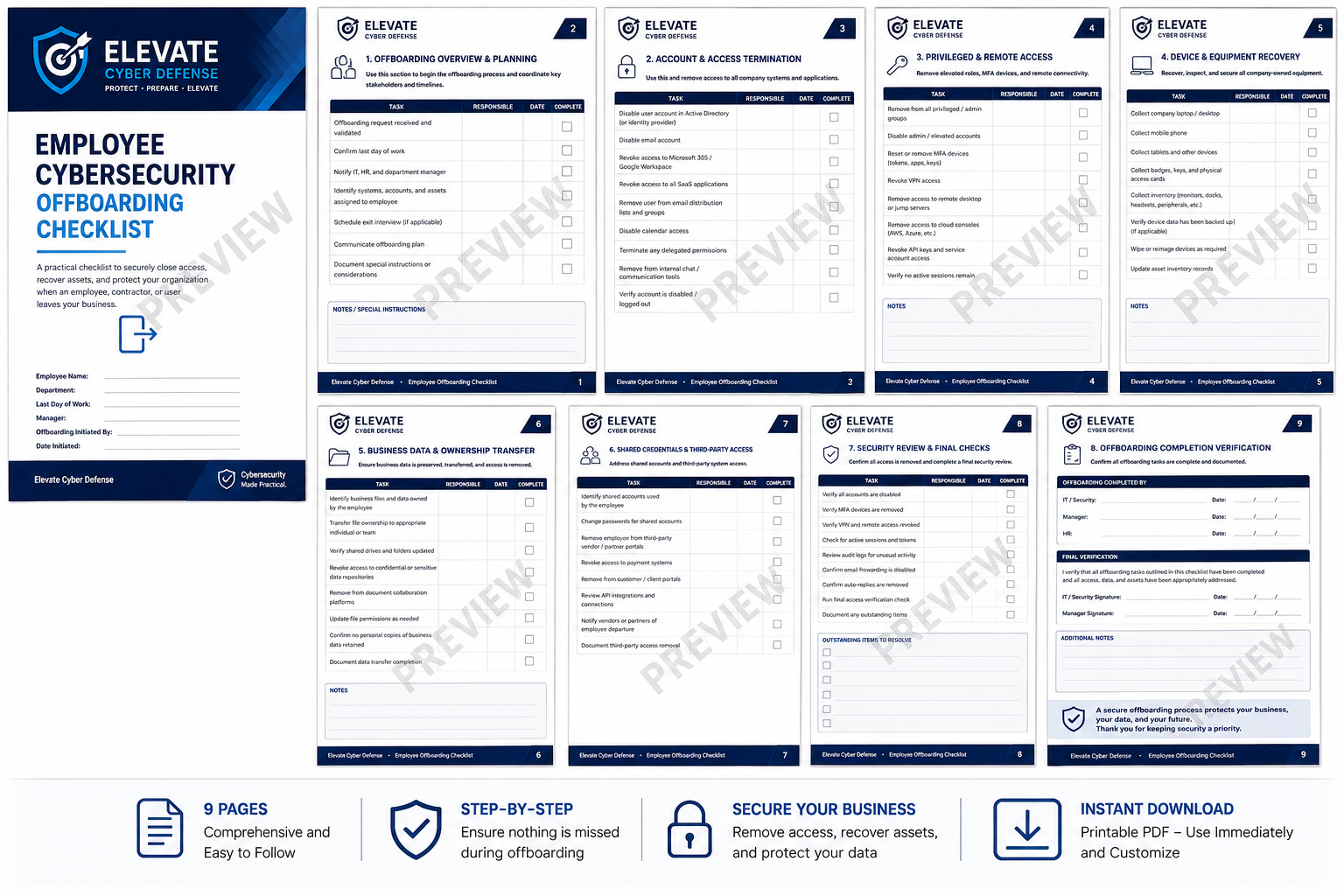
Secure access. Protect business information. Close the gaps when an employee leaves.
The Employee Cybersecurity Offboarding Checklist provides businesses with a structured process for addressing critical cybersecurity tasks when an employee, contractor, or other authorized user leaves the organization or no longer requires access.
Employee departures can create security risks when accounts remain active, company devices aren't recovered, remote access isn't removed, or sensitive business information isn't properly transferred. This customizable checklist helps businesses document and verify important security steps throughout the offboarding process.
Use this checklist to manage and track:
User account suspension and termination
Email and cloud application access
Multi-factor authentication and authentication methods
VPN and remote access removal
Privileged and administrative accounts
Shared accounts and credentials
Company computers, mobile devices, and equipment
Business files and data ownership transfers
Physical access and security credentials
Third-party and vendor system access
Final access verification
Outstanding security issues
Offboarding completion and approval
Designed for small and growing businesses, this resource provides a practical framework that can be customized to fit your organization's employees, technology, policies, and cybersecurity requirements.
Best For: Small businesses, business owners, managers, IT teams, HR teams, and organizations looking to strengthen employee offboarding and access-management procedures.

Work from anywhere—without leaving your business security behind.
The Remote Work Security Checklist provides businesses with a structured approach for identifying and addressing important cybersecurity considerations when employees work from home, remotely, or in hybrid environments.
Remote work can introduce additional security risks when employees access business systems outside the traditional workplace, use home or public networks, handle sensitive information remotely, or rely on laptops and mobile devices. This customizable checklist helps businesses establish and document practical security expectations for remote workers.
Use this checklist to review and manage:
Home Wi-Fi and network security
Company-issued and personal devices
Laptop and mobile-device protection
Password and multi-factor authentication (MFA)
VPN and secure remote access
Cloud applications and business accounts
Email, phishing, and social engineering
Sensitive business information
Secure file storage and sharing
Working from public locations
Physical device and workspace security
Lost or stolen devices
Cybersecurity incident reporting
Remote employee security responsibilities
Final remote-work security verification
Designed for small and growing businesses, this resource provides a practical framework that can be customized to fit your organization's workforce, technology, remote-work arrangements, and cybersecurity requirements.
Best For: Small businesses, remote and hybrid organizations, business owners, managers, IT teams, and organizations looking to strengthen cybersecurity practices for employees working outside the traditional office.

The Data Protection & Backup Security Checklist provides businesses with a structured way to review and document how important business information is stored, accessed, protected, backed up, retained, and recovered.
Business data can be lost or exposed through cyberattacks, ransomware, employee mistakes, hardware failures, stolen devices, unauthorized access, or unexpected system disruptions. Having appropriate data protection and backup practices can help reduce these risks and improve an organization's ability to recover when something goes wrong.
Use this customizable checklist to review and document:
Business-critical and sensitive data
Data classification and handling practices
User access and least-privilege permissions
File and folder access controls
Encryption for stored and transmitted data
Cloud storage and file-sharing security
Local and network data storage
Backup systems and backup schedules
Automated and manual backup processes
Backup access and security
Offline and isolated backup copies
Ransomware protection considerations
Backup monitoring and failure notifications
Backup restoration and recovery testing
Data retention requirements
Secure data deletion and disposal
Lost, exposed, or compromised information
Data protection and backup responsibilities
Identified security gaps and corrective actions
Final review and approval
Designed for small and growing businesses, this resource provides a practical framework for strengthening data protection practices and documenting whether important business information can be securely recovered following a cybersecurity incident, technology failure, accidental deletion, or other disruption.
Best For: Small businesses, business owners, IT teams, managers, security teams, and organizations looking to improve data protection, backup security, and recovery preparedness.
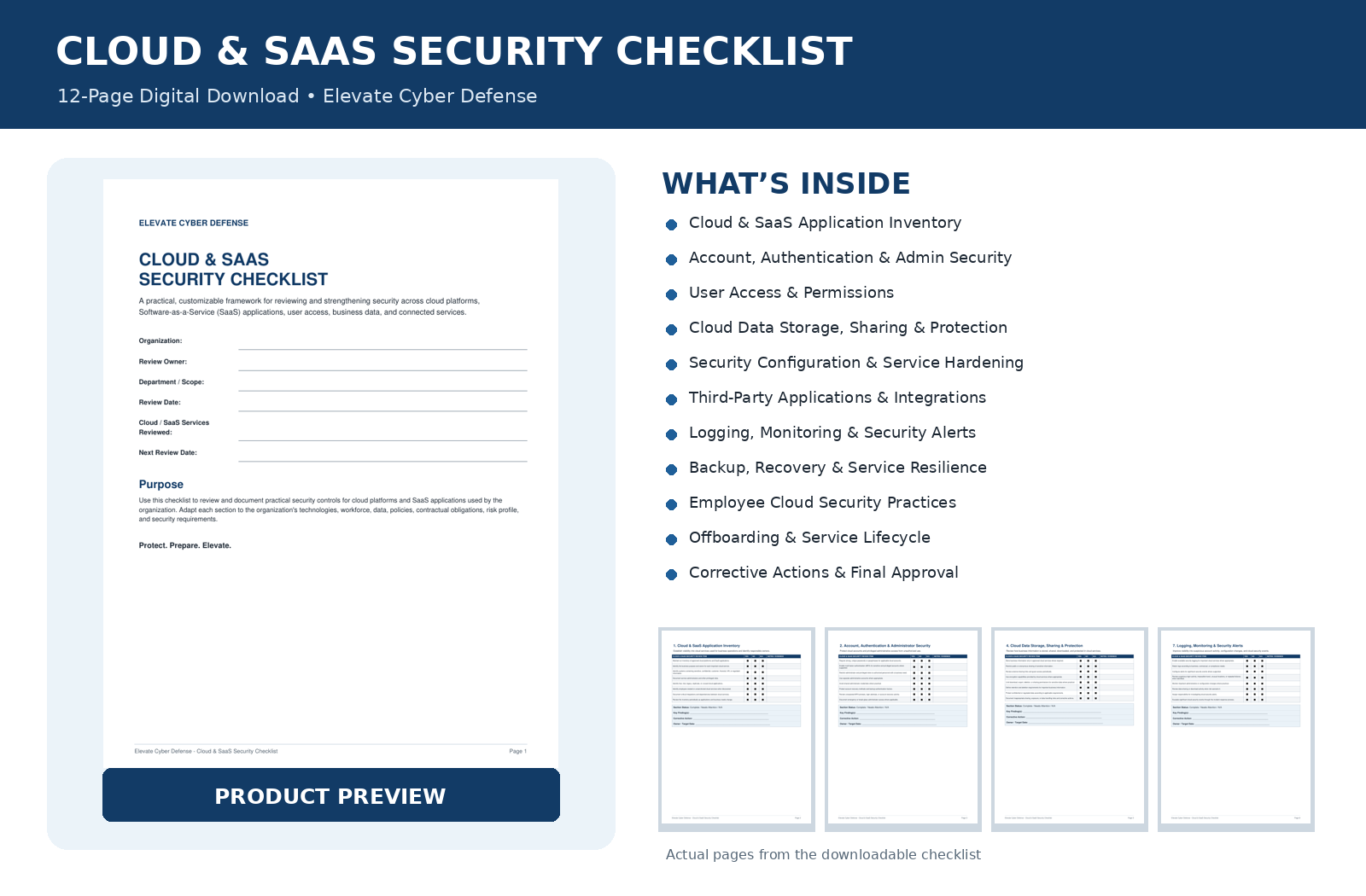
The Elevate Cyber Defense Cloud & SaaS Security Checklist provides businesses with a practical framework for reviewing how cloud platforms, Software-as-a-Service (SaaS) applications, user accounts, business data, and third-party integrations are secured and managed.
This customizable checklist helps organizations identify security gaps, document findings, assign corrective actions, and establish stronger oversight of cloud-based business services.
This checklist covers:
Cloud and SaaS application inventory
Account and administrator security
Passwords and multi-factor authentication (MFA)
User access and permissions
Cloud data storage and sharing
Security configuration reviews
Third-party applications and integrations
Logging, monitoring, and security alerts
Backup and recovery considerations
Employee use of cloud services
Account and access removal
Security findings and corrective-action tracking
Final review and approval
Ideal for small businesses and organizations using services such as cloud storage, email platforms, collaboration tools, accounting systems, CRM platforms, and other cloud-based business applications.
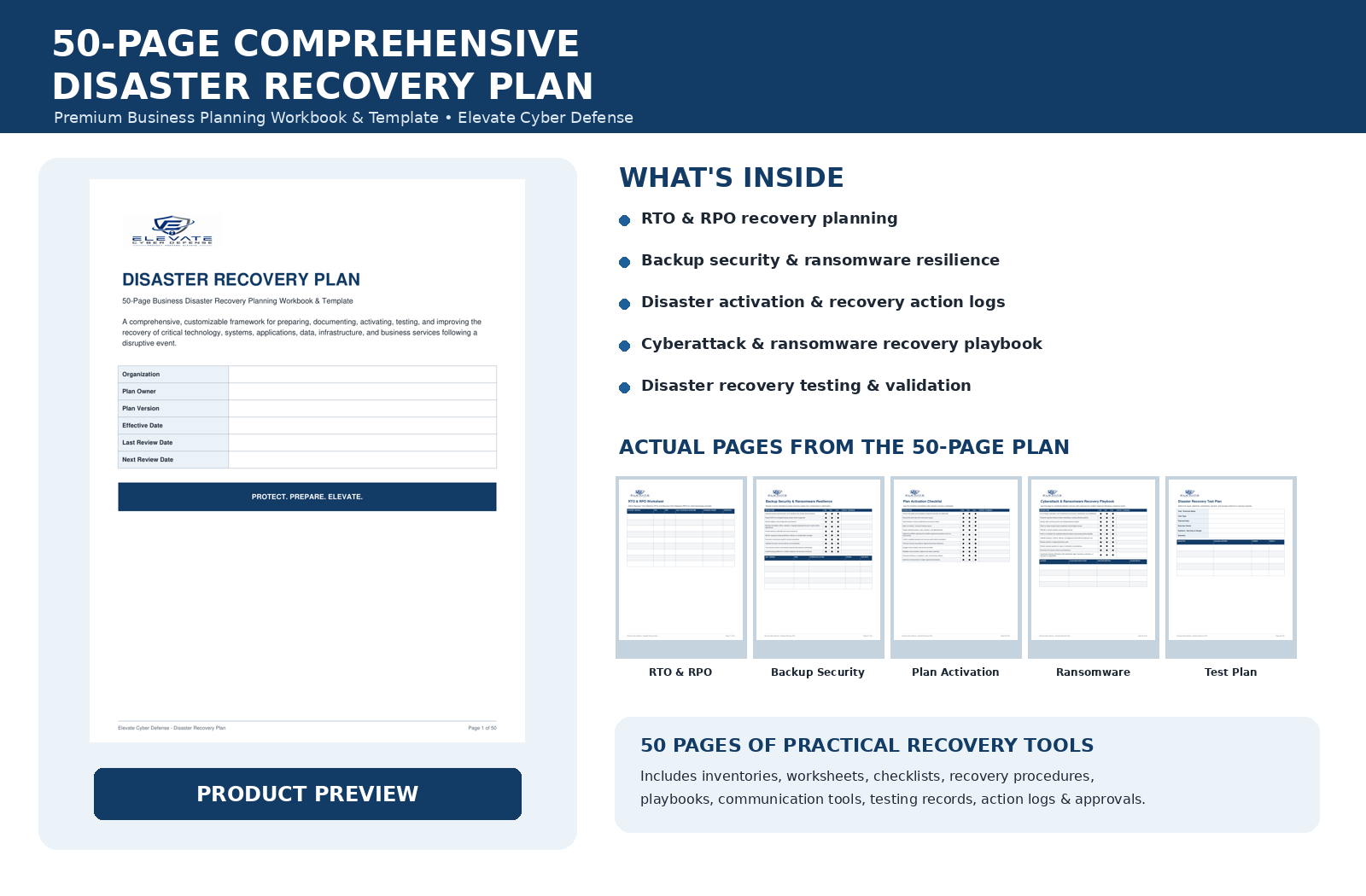
Prepare your business to recover from technology failures, cyberattacks, data loss, system outages, and other disruptive events with a comprehensive disaster recovery framework.
The Elevate Cyber Defense 50-Page Comprehensive Disaster Recovery Plan provides businesses with a structured, customizable framework for documenting how critical systems, applications, data, infrastructure, and technology services will be restored following a disruption.
Unlike a basic disaster recovery checklist, this comprehensive workbook guides organizations through the entire recovery process—from identifying critical systems and establishing recovery priorities to documenting backup strategies, recovery procedures, communication plans, testing, corrective actions, and final plan approval.
This 50-Page Plan Includes:
Disaster Recovery Plan governance and document control
Plan purpose, scope, objectives, assumptions, and constraints
Disaster recovery roles and responsibilities
Recovery team contact directory and emergency call tree
Critical Business Functions and Business Impact Analysis
Critical systems and applications inventory
Infrastructure and network inventory
Data and information asset inventory
System dependency mapping
Vendor and third-party recovery dependencies
Recovery priority classifications
Recovery Time Objective (RTO) and Recovery Point Objective (RPO) worksheets
Minimum service and recovery requirements
Backup strategy, inventory, and schedules
Backup security and ransomware resilience
Backup restoration testing records
Alternate processing and recovery locations
Replacement hardware and equipment planning
Software, licensing, and installation resources
Credential and privileged-access recovery
Disaster declaration criteria
Disaster Recovery Plan activation checklist
Initial damage and impact assessment
Recovery decision and action logs
Internal and external communication planning
Stakeholder notification templates
Cyberattack and ransomware recovery playbook
Server and virtual machine recovery procedures
Database recovery procedures
Network and connectivity recovery procedures
Cloud and SaaS recovery procedures
Endpoint and workforce recovery procedures
Email, collaboration, and identity recovery
Physical site and facility technology recovery
Power, internet, and telecommunications failure playbook
Data corruption and accidental deletion recovery
Recovery validation and acceptance checklist
Return-to-normal operations checklist
Disaster recovery testing plan
Test execution and results documentation
Lessons learned and corrective-action planning
Annual review and maintenance checklist
Final approval and plan authorization
Designed for Practical Business Use
This plan gives small businesses and growing organizations a structured way to prepare before a disaster occurs, instead of determining recovery procedures during an emergency.
Use the worksheets, checklists, inventories, recovery procedures, tracking tables, and approval sections to develop a disaster recovery strategy tailored to your organization's technology environment and operational needs.
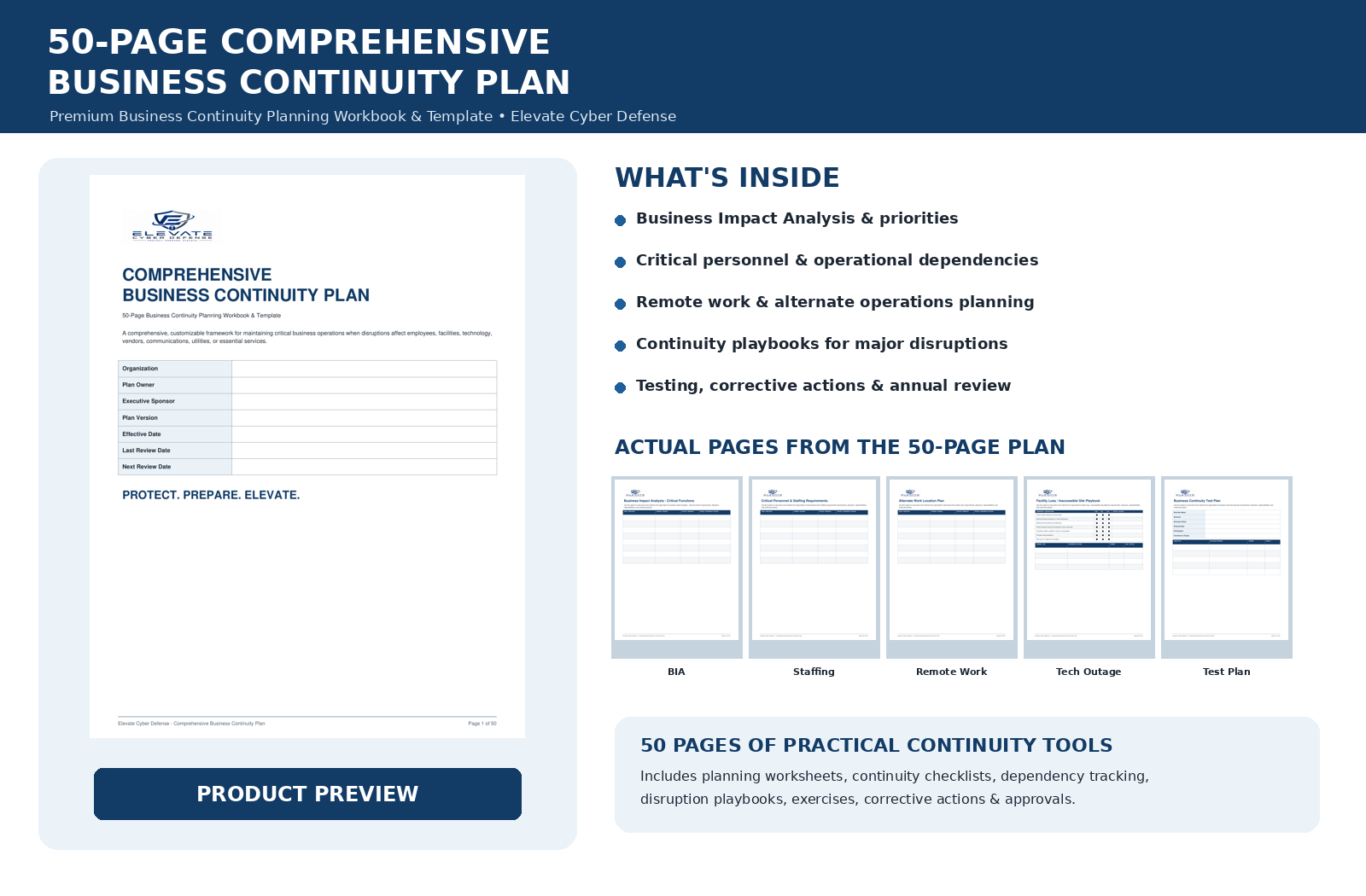
Prepare your business to continue critical operations when unexpected disruptions affect employees, facilities, technology, vendors, communications, or essential business services.
The Elevate Cyber Defense 50-Page Comprehensive Business Continuity Plan provides businesses with a structured, customizable framework for identifying critical operations, preparing for disruptions, establishing continuity strategies, and maintaining essential business functions until normal operations can be restored.
Rather than trying to determine how your organization will continue operating during an emergency, this comprehensive plan helps establish business priorities, responsibilities, alternate operating procedures, communication processes, technology dependencies, vendor requirements, recovery objectives, and continuity strategies before a disruption occurs.
This Comprehensive Plan Covers:
Business Continuity Plan governance and document control
Plan purpose, scope, objectives, and assumptions
Business continuity roles and responsibilities
Continuity team contact information
Emergency escalation and activation procedures
Business Impact Analysis (BIA)
Critical business functions
Essential products and services
Maximum tolerable downtime
Recovery priorities
Minimum acceptable operating levels
Critical employees and staffing requirements
Cross-training and backup personnel
Technology and system dependencies
Critical data and information requirements
Facility and workspace dependencies
Alternate work locations
Remote-work continuity procedures
Internet and telecommunications continuity
Power and utility disruptions
Manual business-process workarounds
Critical equipment and resource requirements
Vendor and supplier dependencies
Third-party service-provider continuity
Supply-chain disruption planning
Customer and client communication
Employee communication procedures
Leadership and stakeholder communications
Emergency contact information
Business continuity activation checklist
Initial disruption assessment
Continuity decision log
Continuity action tracking
Facility-loss response planning
Technology-outage continuity procedures
Cybersecurity-incident continuity planning
Staffing-shortage procedures
Vendor and supply-chain disruption procedures
Severe weather and regional disruption planning
Alternate operating procedures
Essential records and documentation
Financial and administrative continuity considerations
Transition back to normal operations
Business continuity testing
Tabletop exercise planning
Exercise results and documentation
Lessons learned
Corrective-action tracking
Annual plan review and maintenance
Management review and final approval
Designed for Real Business Continuity Planning
This plan gives businesses a structured way to determine how essential operations will continue when normal business processes are disrupted.
The included worksheets, checklists, planning tables, continuity procedures, dependency records, communication tools, action logs, testing documentation, and approval sections help organizations develop a continuity strategy tailored to their actual operations.
It also works alongside an organization's Incident Response Plan and Disaster Recovery Plan, helping connect cybersecurity response, technology recovery, and continued business operations into a more complete resilience strategy.
Ideal for small businesses, growing organizations, business owners, IT teams, operations teams, and organizations strengthening their overall preparedness and resilience.